
taking time out
to rest in shavasana

Walk Slowly
It only takes a reminder to breathe,
a moment to be still, and just like that,
something in me settles, softens, makes
space for imperfection. The harsh voice
of judgment drops to a whisper and I
remember again that life isn’t a relay
race; that we will all cross the finish
line; that waking up to life is what we
were born for. As many times as I
forget, catch myself charging forward
without even knowing where I’m going,
that many times I can make the choice
to stop, to breathe, and be, and walk
slowly into the mystery.
-Danna Faulds
We need to move. This is a given.
But we also need to rest, to find time to pause, to balance doing and non-doing, activity and stillness.
If we forget this, we tend to hold onto things. We carry them with us. We may not sleep well. Our worries and stresses - both large and small - accumulate. If we never find ways to put these down, we end up feeling frazzled and depleted.
In order to physically quieten ourselves, we need to quieten our muscles. Muscles relax when they are supported. Shavasana is perfect: the whole weight of the body is supported by the ground, the head can fully rest, and we start to let go.
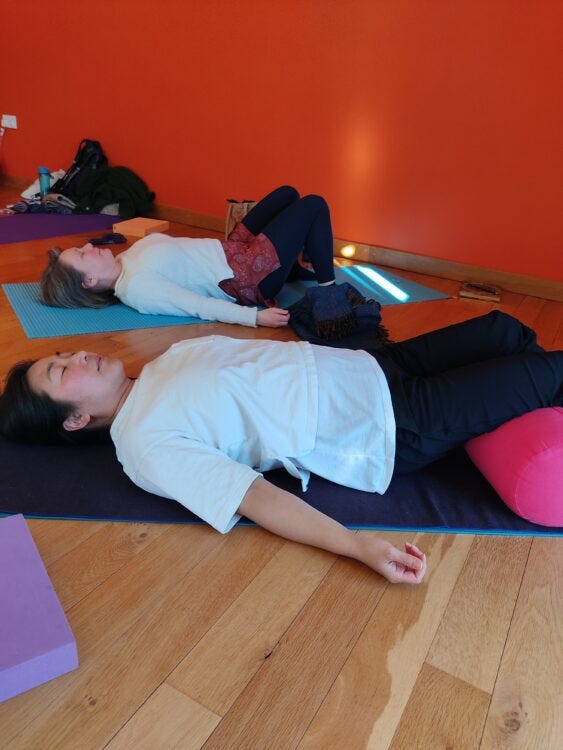
But…
we can lie in shavasana and find the mind is not ready to put things down. We find ourselves thinking about the to-do list, the news, a problem that needs our attention.
Perhaps we then rush through shavasana - or miss it out entirely. Perhaps, instead, we collapse in a chair and read the news, or scroll…
But shavasana is a practice that offers us a quiet space like no other. To hold this space for ourselves, we must pay attention to the body, and not to our ruminatory thoughts.
So, to take time to organise ourselves comfortably into the pose is important. A body scan is helpful. Breath awareness is another tool we might use, or mental repetition of a mantra, if the mind is very scattered.
Most of the adrenaline circulating in our system will be reabsorbed by the liver quite quickly, within 3-5 minutes. The frayed feelings start to diminish. We feel a little calmer and quieter. A longer shavasana - of 20-30 minutes - can lead us into deeper states of calm and quiet.
This is not withdrawal, or escapism.
The body can only really heal when stress hormones are reduced; we can only feel resourced, awake, rooted and courageous in the face of the troubles of the world if we allow ourselves the space to rest. To give ourselves time to calm ourselves in this way becomes vital.
At its most profound, however, shavasana is more than rest.
Lying flat on the ground with the face upwards, in the manner of a dead body, is shavasana. It removes tiredness and enables the mind to relax.
Hatha Yoga Pradibika 1:32 - 15th Century CE
Shavasana is a practice: an active practice of stillness and surrender. The final pose. The word shava means corpse. In my early days of teaching, I explained this to a class and one of my students afterwards told me how shocked she was. Our culture avoids, ignores and fears death. But here is a gentle way to rehearse that final letting go. In completely surrendering the body to the earth below, we can rest in a kind of unknown space that, over time, can reveal something to us about the mystery of life and death.
In our restless world of overstimulation, we need this route into the deep, quiet heart of yoga more than ever.
As many times as I
forget, catch myself charging forward
without even knowing where I’m going,
that many times I can make the choice
to stop, to breathe, and be, and walk
slowly into the mystery.
The hardest things seem the simplest.
It helps if your yoga teacher has a voice for radio too.